📞 Call (912) 214-8566 — Free Estimate
Professional Tree Health Assessment in Savannah, GA
Tree health problems in Savannah rarely announce themselves clearly. A tree can look reasonably healthy from the ground while carrying significant internal decay, root disease, or structural weakness that makes it a genuine hazard. Savannah Tree Co provides professional tree health assessments for residential and commercial properties throughout the Savannah metro area — giving you an accurate picture of what your trees are actually doing and what, if anything, needs to be done about it.
Coastal Georgia’s climate is demanding on trees. High humidity, warm temperatures, sandy soils with variable drainage, and seasonal storm stress create conditions where fungal disease, pest infestation, and root problems develop faster than in drier inland climates. Early identification of these issues gives you options. Left undetected, the same problems can turn a manageable situation into an emergency removal.
What a Tree Health Assessment Covers
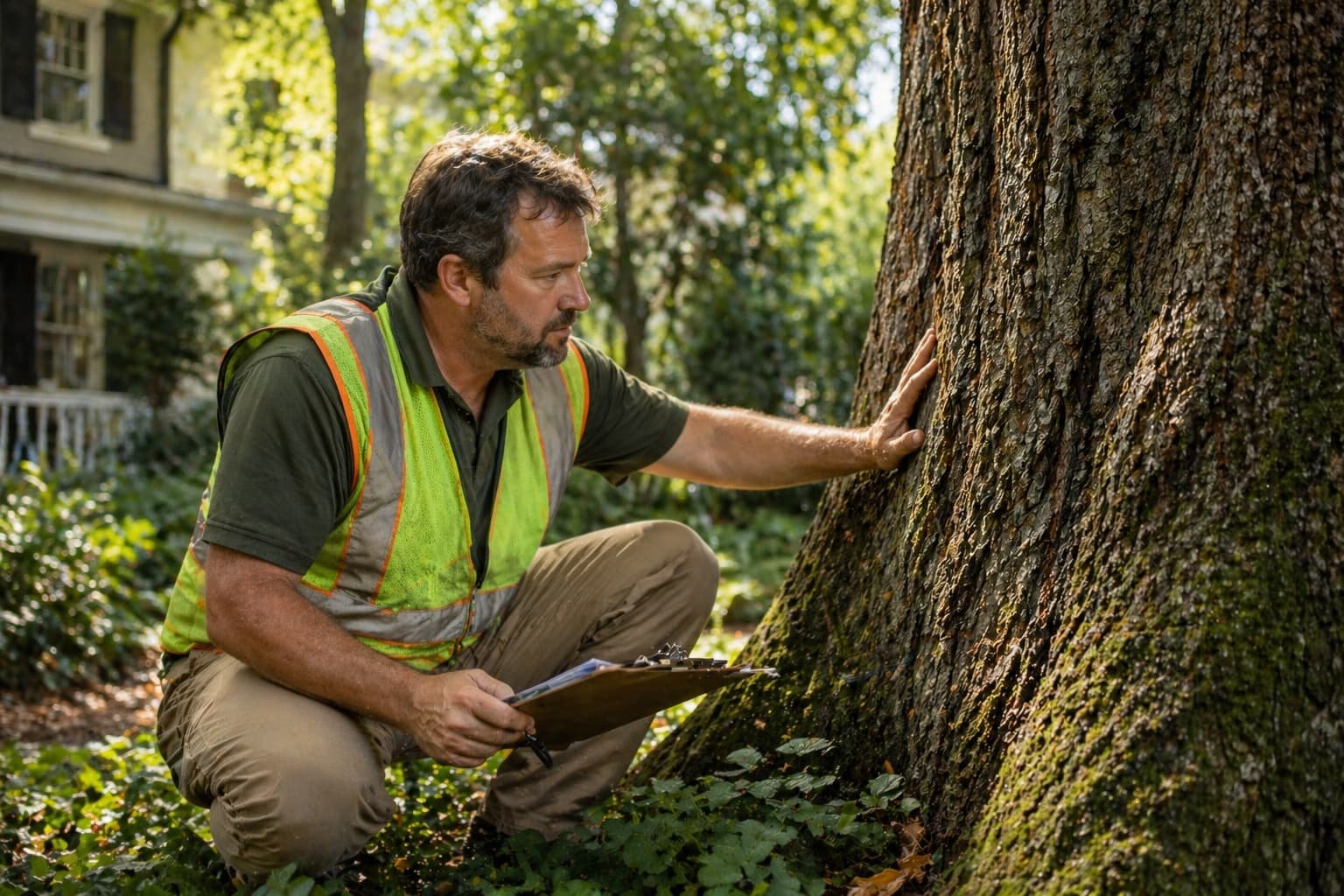
A thorough assessment looks at the whole tree — from the root zone at ground level to the upper canopy. At ground level, we check for root damage, soil compaction, signs of fungal growth at the base, and evidence of root girdling or construction damage to the root zone. These issues are often invisible until they have progressed significantly, which is why a trained eye matters.
On the trunk, we look for cavities, cracks, loose bark, fungal conks, and signs of insect activity including bore holes and sawdust accumulation. Trunk issues indicate internal decay that cannot be seen from the outside but can be assessed through probing and visual inspection of the wound patterns.
In the canopy, we assess branch structure for included bark, co-dominant stems, and crossing branches that create long-term structural weakness. We look for deadwood, leaf discoloration, abnormal growth patterns, and signs of pest damage. Canopy thinning, early leaf drop, and off-season foliage changes are all indicators of underlying stress.
Common Tree Health Issues in Savannah
Several conditions appear consistently across Savannah properties. Laurel wilt disease affects redbay and sassafras trees and spreads rapidly through the ambrosia beetle. Oak wilt, while less prevalent in coastal Georgia than further inland, is an emerging concern. Hypoxylon canker affects stressed oaks and is often a secondary condition following drought or construction damage to the root zone.
Ganoderma root rot is a significant concern for palms and some hardwoods — it destroys the structural integrity of the root system while the tree may still appear superficially healthy. By the time external signs appear, the tree is often already a serious fall risk. Spanish moss, while iconic in Savannah, can accumulate to a weight that stresses weaker branches in older trees.
Construction activity is one of the leading causes of delayed tree decline in urban Savannah. Root zone compaction and damage during renovation projects kills trees slowly — the tree may survive for two to five years before the decline becomes visible, at which point homeowners are often unaware of the original cause.
When to Book an Assessment
There are specific situations where an assessment should not wait. If a tree has recently been struck by lightning, has visible cracks or splits in the trunk, is leaning more than it used to, or has large areas of dead canopy, call us promptly. These are signs of potential structural failure. Similarly, if a tree has been subjected to construction activity near its root zone in the past few years, an assessment is worthwhile even if the tree currently looks healthy.
For routine maintenance, we recommend assessments every three to five years for mature trees on residential properties, and annually for trees close to structures or with known prior issues. The International Society of Arboriculture provides standards for tree risk assessment that guide our evaluation process on every job.
Assessment Outcomes
At the end of every assessment, we give you a clear picture of what we found and what we recommend. That may be nothing — a clean bill of health is a valid outcome and a worthwhile one to have documented. It may be a recommendation for targeted pruning to remove deadwood or correct structural issues. In cases where the tree presents a genuine risk, we will tell you that directly and explain why.
We do not recommend removal unless it is genuinely warranted. Our goal is to give you accurate information so you can make an informed decision about the trees on your property. Call us at (912) 214-8566 to schedule an assessment.
Frequently Asked Questions
How do I know if my tree needs an assessment?
If you have noticed changes in the tree — unusual leaf drop, canopy thinning, cracks in the trunk, fungal growth at the base, or a change in lean — book an assessment. If you have not noticed anything but have mature trees close to your home, periodic assessment is good practice regardless.
Can a diseased tree be saved?
It depends on the disease, how far it has progressed, and the overall condition of the tree. Some conditions respond well to treatment or targeted pruning. Others, particularly advanced root rot or systemic vascular diseases, are not treatable and the tree will need to be removed before it becomes a hazard. We give you an honest answer based on what we find.
Does an assessment mean you will recommend removal?
Not necessarily. Many assessments result in a recommendation for monitoring, pruning, or treatment rather than removal. We only recommend removal when the tree is genuinely hazardous or so far in decline that intervention is not viable.
How long does an assessment take?
A standard single-tree assessment takes thirty to forty-five minutes. Properties with multiple trees take longer. We walk the property with you and explain what we are looking at in plain language as we go.